
What Makes Ecstatic Dance Sacred?
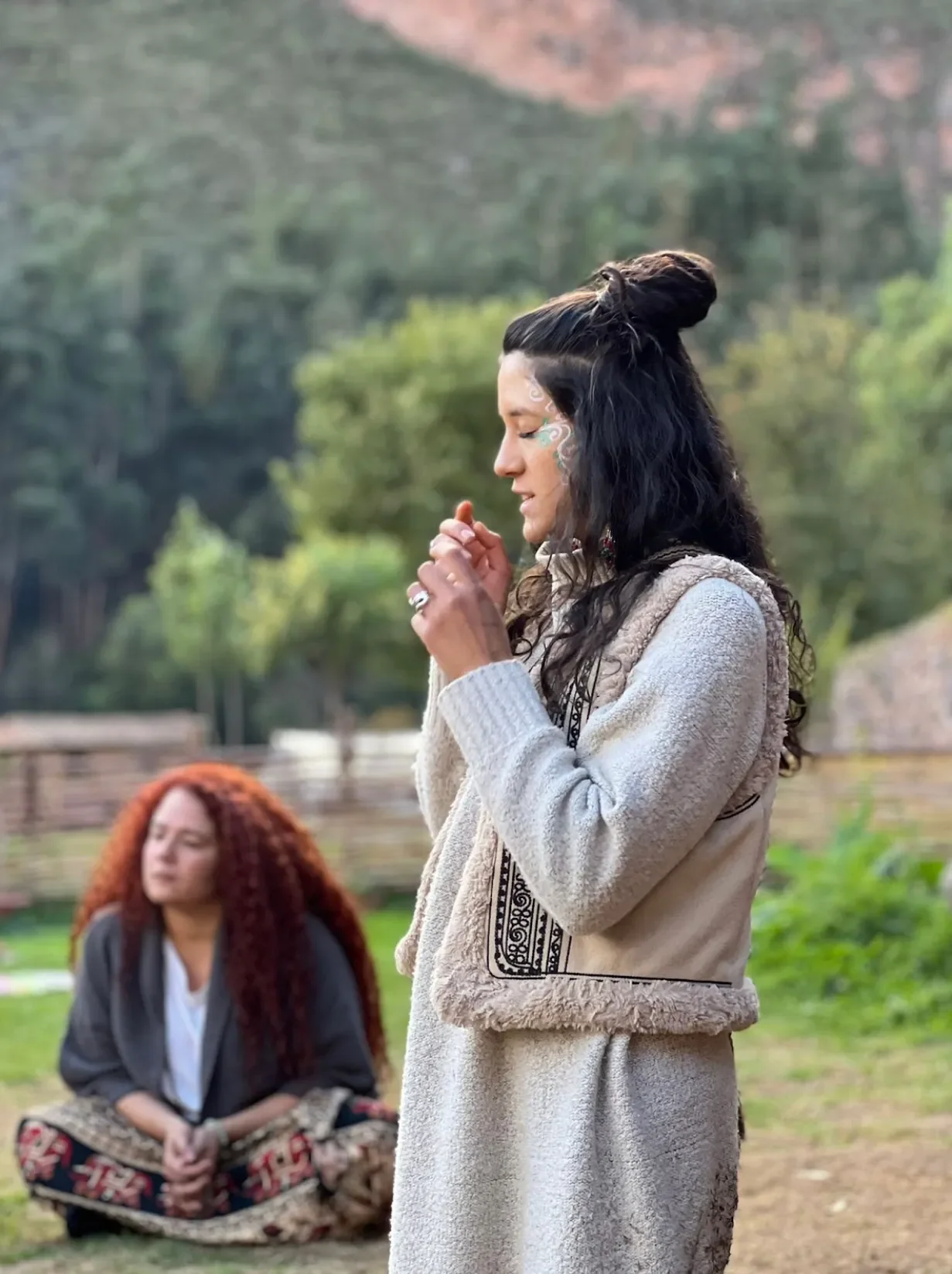
Before lighting a candle on the Kali Ma inspired altar, I set the intention for this week’s Ecstatic Dance to support women in releasing their inner-wild Shakti. May every woman who shows up this evening feel supported in going all out with their swaying hips, thrusting chest, and fairy fingers. May grunts and howls be blown out from the bones of women. May this space be a non-judgment timeless zone. May we heal through dance, zero holding back. May this be THE SPACE where community witnesses one another in their free expression without words. May everyone respect the sacredness of ecstatic dance and find corner pockets or entire avenues of joy where they lose themselves altogether. May every person who dances tonight enter a rhythmic harmony and receive the guidance they have been outsourcing externally. These were some of my prayers as I lit the white candle on my Kali Ma altar.
During the opening circle after the cacao ceremony I’d invite participants to add their sacred objects to the altar and pick an oracle card throughout the dance.
If you’ve never been to a proper ecstatic dance you may be thinking what kind of Neo-shamanic, white-washed, New Age, spiritual bullshit type of claim is this? Can we please stop with the over saturation of spirituality? Calling everything sacred doesn’t make it sacred. No, it doesn’t. I’m right on board with you skeptics and gate-keepers of reason, decolonization, and ancient, authentic, spiritual practices.
However, I’m here to cover why Ecstatic Dance is indeed sacred when the guidelines that create safety are honored, and how I see it being distorted due to a lack of ethics in The Sacred Valley, Peru (and other “energetic New Age vortexes”).
What Is Ecstatic Dance Exactly?
Ecstatic Dance is a conscious community dance event with a live DJ that lasts anywhere from 2 to 6 hours. Everyone and anyone is welcome to come free-dance (or sit, watch, meditate, crawl, roam, write, shake, cringe) as long as the 5 guidelines are adhered to. During the dance there should be; no talking, no phones, no substances, no shoes, and no judgment.
There’s always an opening and closing circle. Participants are encouraged to become like children, animals, and sensual beings unafraid to unleash their uninhibited nature. That’s the invitation for any Ecstatic Dance. Dance freely, joyfully, dramatically, therapeutically, authentically. All of you (every part) is welcome here. So please, stretch yourself past your comfort zone. You’re in a safe zone to do so. Just make sure to follow the guidelines ahem.
Some facilitators like myself truly treat it as a ceremony. There’s a container with a clear start, middle, and end point. A strong intention for personal and collective liberation is established on a weekly or monthly basis. The artists that contribute are in alignment with the direction consciousness in moving in; healing. People attend to express parts of them they can’t access or easily fully embody in other group spaces.
The experience of receiving high frequency sound vibration, engaging in free-flow dancing, and witnessing while being witnessed by the community becomes transcendental and deeply liberating.
Ecstatic Dance Origin
The Latin word origin for ecstatic is ekstasis meaning, “standing outside oneself.” Forms of ecstatic dance where people lose themselves in movement are found in ancient history from various traditions. In tribal rituals and ceremonies, dance has always been a way to connect with the divine. From Brazil to Japan dance has been used as a form of worship, self-expression, and as a means to release the dancer from the egoic self. Even in Evangelical Christianity dance has been used to enter powerful trances.
Gabrielle Roth is the person who formalized ecstatic dancing during the 1970s in her 5Rhythms practice. Then, in 2001, Max Fathom fused 5Rhythms with electronic music and live performing artists to create Ecstatic Dance on the Big Island in Hawaii. Fast forward to 2015, Ecstatic Dance International was founded by Donna Carroll to include training on how to create an ecstatic dance community. It’s this structure that has allowed Ecstatic Dance to spread worldwide today.
The problem I see is Ecstatic Dance spreading in places where facilitators have little consideration for the guidelines, don’t rely on a team, aren’t ethical leaders, and mask self-interest behind community organizing. Events that are talkative, substance tolerating but still differentiate themselves from your typical party should be called conscious raves, not Ecstatic Dance. It’s very misleading for the movements' revered and sober, transcendental intentions.
Ecstatic Dance As A Pathway To Somatic Therapy
We gather to become free from shame, fear, rigidity, and lower vibrational states through our dance together. We dance with devotion for life itself and (you)niversal healing. We dance for unity. We dance for peace. We dance to rid away the illusion of separation. We dance to feel the raw power inside our body; to know ourselves as sovereign, capable of small and big change. We dance to feel more connected, rooted, alive, and creative.
We dance to afterward take the vital energy we harnessed as a collective in our bubble of ecstasy, into our week, into our relationships, into our projects.
If you let yourself get fully into it, as in out of mind, and into body, Ecstatic Dance becomes a direct gnosis with the Universal Law of Correspondence (our outer world is a reflection of our inner world). The more we move consciously in a space attuned to spiritual growth, the more we somatically resolve and bring light to. A ripple effect is created in our personal lives. Things really start to shift in massive ways.
I saw a meme once that read:
“Ecstatic Dance changed my life.
-Said everyone ever.”
It’s true. The “container” for this ceremony is held so pristinely, the intention so pure, that it just so happens, people experience for the first time ever, the freedom of expression that is possible absent from judgment in a safe space with little guidance.
Our dance becomes an opportunity to transform our inner-world. In other words, for many, Ecstatic Dance is somatic therapy. This means on the dance floor you’ll see people having cathartic emotional releases. Expect shaking, crying, yelling, crawling on the floor, etc.
You’ll see dancers doing energy work on themselves or engaging in practices like qi-gong, yoga, and womb breathing. Ecstatic Dance draws in many healers, yogis, trail blazers, artists, and overall sensitive souls who have simply had to learn energetic tools to support themselves in a harsh world. It’s not a party, it’s a transcendental experience with no drugs involved.
The Dance Floor As A Temple For People Recovering From Trauma
When the rules are you remain sober, don’t talk on the dance floor, don’t use your phone throughout, and leave your judgments aside, we have ourselves the setup toward a sacred space. Just as you would approach a temple with a slow meditative walk, the culture of Ecstatic Dance is one of reverence.
Ecstatic Dance brings in a lot of “conscious” folks in trauma recovery because it’s one of the few celebratory big-group spaces that is founded on safety. Knowing you won’t be photographed or recorded, interrupted with small talk, and everyone is in their “right state of mind” creates the feelings of safety. So does knowing the collective intention is one of liberation, healing, welcoming all parts of you, and accessing joy. If you cry, it’s a quiet celebration. The awareness that releasing emotional blocks is a good thing in the Ecstatic Dance space is held by the facilitators, team, and community.
The energy embodied people on the dance floor transmit is contagious. It may take you attending three events to dance without care, but you’ll get there. And if you let it, it’ll change your life.
Trauma, after all, are the stuck emotions that live within the nervous system. It’s the kinks in the hose that prevents us from being with present moment awareness. Entering a space where you see dancers treat their body as a temple instantly gives you permission to explore yours just as courageously. Dance liberates you emotionally, no question about it.
We need liberating spaces for our somatic full-expression to be explored. The beauty of Ecstatic Dance is we all come together to do this sober which often means working through a lot of mental blocks at first. This is where the artists come in to elevate the energy. It’s common for Ecstatic Dance DJ’s to incorporate Alan Watts or Mooji voice overs that cut right through to the core of your heart, interrupting those repetitive thought patterns. Warm ups with guided movement are also quite common in the beginning of the dance to loosen everyone up.
I always tell people during the opening circle, unless someone asks for assistance, leave them alone. It’s normal to feel impacted when heavy emotions arise in others but most people who aren't trauma-informed, though well-intentioned, can cause more harm than good in those vulnerable moments. No one is there to play therapist or savior. However, a good team will have trauma-informed people who can offer support to someone going through a cathartic emotional release.
Spontaneous releases happen when the body feels tethered to safety. Like when someone at church suddenly starts speaking in tongues, dancers enter trances that produce cathartic experiences. All in all, when the space is held pristinely, dancers touch a quality of depth within themselves that increases confidence, motivation, compassion, and presence.
A Temple is Only As Sacred As it’s Gatekeeper’s Ethics
Just as every temple from every tradition is unique in its practices, norms and customs, so is every Ecstatic Dance. You know how religious and spiritual institutions help masses yet uncover abuse from certain priests, gurus, shamans, or cult leaders? Sacred doesn’t equal safety. Practicing spirituality doesn’t automatically give someone ethics.
A good facilitator will inspire curiosity, safety, and reassurance that everyone is welcome to move (or not) as they please. A consent culture has also been established within Ecstatic Dance that explicitly states if you want to dance with someone, ask first.
The universal sign for “no, thanks” is hands in prayer with a silent bow (Namaste). No creeps allowed.
Actually, this is one of the few spaces where you can rest assured no weirdos will suddenly rub up on you. God, how yucky that feels. In the event that your boundaries do get crossed, there will be safe-keepers like a trusted team you can turn to to handle any situation that comes up.
It really boils down to the facilitator and what they transmit to their team. As with any personal development retreat, yoga class, plant medicine ceremony, pilgrimage, vipassana, dance event, coaching or therapy container, the space, organizer and facilitator set the stage.
What Are The Ethics A Guide of Sacred Dance Space Should Uphold?
For starters, they shouldn’t be sexually promiscuous.
Ecstatic Dance is a vulnerable space with a large intention on healing. People open up their energetic fields tremendously, meaning after a dance you may feel quite “open” and become prone to be easily suggestible or impressionable. The person who leads a dance (or any consistent spiritual space) gains a great amount of power. They are basically the person who unites and grows the community. The assumption is they’re a grounded, respectful, and safe person.
We assume leaders have risen into power because they have ethics. In reality, many emerging spiritual leaders and industries have no regulatory body or wise elders keeping them in check. Sexual promiscuity in spiritual leaders is a huge red flag. There are reasons why spiritual leaders have traditionally taken vows of abstinence, there exists huge potential for harm. Especially because many Ecstatic Dance attendees are young, vulnerable, women who are recovering from sexual trauma and harnessing their power.
We’re not saying sexuality can’t be expressed by a spiritual leader, on the contrary, they should set the example for the direction consciousness is moving in; healing. Lustful energy has little consideration for causing harm, after the instant gratification is achieved, there’s typically an abandonment. Beware of lustful leaders with narcissistic tendencies. They are not the people you want holding a space meant for emotional liberation and community growth.
Secondly, any sacred space facilitator should be asking for constant feedback.
Asking for feedback from their team, community, the people they serve, is a sure way to keep improving as the network they’re weaving continues to expand. A humble and curious attitude is important because without it, the ego easily becomes inflated and with that, the knob for conscious empathic awareness turns down.
Sacred space implies no energy leakages which result from disordered boundaries. Energy leakages happen when you refuse to work on yourself leading to messy, unclear boundaries which become the antidote to a harmonious space.
Here it’s important I point to narcissists within the spiritual community who run rampant. The thing is we live in a narcissistic society so the fact that many of our leaders are narcissists isn’t a big surprise. The point we at Haramara Sal Sanctuary wish to make is to become aware of who and what you choose to support. If the energy at a place meant for healing feels off, please explore that intuitive nudge instead of riding it off.
Narcissists are people who are very, very charming when they need to seduce you. However, once they have you on their team, they move on to the next people they need to seduce. Those who have already been recruited are disregarded and discarded. They are people who lie pathologically and have very little empathy. They’re hard to spot and stop since they’re so charming and skilled at defending themselves. Although this is just a psychological label it helps us identify the patterns in spiritual leaders who abuse their power. You won’t see them authentically asking for and listening to feedback.
Thirdly, they should be clear and coherent with their communication.
Words should match actions, always. Mistakes are guaranteed to occur. However, an ethical leader takes ownership and responsibility by communicating tactfully at all times. Beware of red flag behaviors like unclear communication around payment, timing, and role expectations.
Facilitators are kind and compassionate people with strong boundaries.
An altruistic character includes everyone, has no hidden agendas, and won’t give you an “off” feeling. Compassionate people can step into the shoes of another and offer kindness in any given moment. They’ll have clear boundaries which may be stern but for the highest good of the intention of the healing space.
Ecstatic Dances Bloom in Places Without Strong Ethics
When a practice deviates far away from its origin, calling it by another name is best. Cultural appropriation is a huge issue in spiritual hubs which simply points to weak ethics and the consumerist, extractive, culture we’ve grown up in.
Where Ecstatic Dance goes wrong is in spaces where the guidelines aren’t honored. Imagine people on their phone, talking on the dance floor, and some on mind-altering substances. The result is that energy gets leaked. There are no clear boundaries. It’s no longer a “safe” space because the very foundations have been disrupted.
When A Space Stops Being Sacred & Safe
Psychedelics dissolves boundaries, compromises decision-making, and lowers inhibitions. There are time and spaces for this that require safety and trauma-informed guides. Ecstatic Dance isn’t it.
Something I witnessed in The Sacred Valley where psychedelic tourism has skyrocketed is people chit-chatting and using their phones on the dancefloor. This made it feel more like a party than a safe space for emotional liberation and spiritual connection. It should perhaps be called a conscious rave, instead of an Ecstatic Dance.
Unethical Facilitators On The Rise
I know a lovely Ecstatic Dance facilitator from my time living in Vilcabamba, Ecuador, who’s a radical Tantric teacher that’s been holding a very tight container consistently every week for over 10 years. By tight container I mean there’s strictly no talking, no phones, no filming, and always a strong opening and closing circle. The DJ’s are also all Ecstatic Dance trained to take people on a journey with a slow rise, peak point, and slow close. She does not however, imply a strict no substance rule. Since she smokes cannabis, the space is open for cannabis smoking.
We understand many people turn to psychoactives to get out of the mind and into the body. I wouldn’t consider the space unsafe because some people were high. The facilitator, as an older woman with strong ethics and clear boundaries, was always present to make sure everything flowed smoothly, as did her team. So, it always depends on the level of integrity the facilitators hold. This is the one unique exception I’d make to the no substances rule. Because of her reverence for what Ecstatic Dance is at its core, the space remained safe and supportive.
Unfortunately, what I experienced in the Sacred Valley was an organizer with multiple sexual abuse claims and a community that had no idea what to do about it. It’s paramount that facilitators of sacred spaces like Ecstatic Dance be safe people with high moral codes. Otherwise, leaders who re-traumatize with zero accountability lead masses into more confusion in covert ways.
We advise especially younger folks to stay clear of any spiritual spaces that feel “off.” If something feels sketchy, inquire into who the organizer is and what reputation they have before attending. You may save yourself from icky situations.
Adequate training helps facilitators of Ecstatic Dance grow into trustworthy space holders. Since this is a space where many people come to free themselves somatically, we don’t want a culture of weak boundaries being exploited.
Age Of The Dark Feminine
Dance is a feminine practice that helps nurture the wounded sexuality we’ve inherited, back to balance, for both men and women. Dark femininity rising points to the capacity each person has to bring their shadows to light, unconscious to conscious, fragmented parts to wholeness, and thus heal their relationship with all of creation. Since every person was born from a dark, watery, womb, it’s our task as awakening souls in human bodies to own our sexuality, expression, and start dancing once again with the spiraling, cyclical nature of life. Ecstatic Dance is a safe space to explore deep aspects of the self.
During the closing circle that evening, some women and men shared that this dance had been the most powerful thing they had ever done in their entire lives. One woman shared she had never felt so free in her body and so safe to dance sensually. Others shared how the oracle card they picked gave them a message that brought clarity to their current situation. The cacao ceremony blasted our hearts wide open and reminded us to trust in life in more surrendered ways. Bonds between participants were formed and spirits were alleviated. Worries were cast away and connection was restored. We ended the evening with grateful hearts and a full tank of energetic fuel to ripple love, acceptance, openness, inspiration, empathy, and compassion into the rest of our week.
Ecstatic Dance is a sacred space for modern people to experience deep connection, somatic therapy, create new bonds, and access high states of joy. Please stop supporting people who claim this title without honoring the guidelines and intentions. Encourage them to call it something else.
Haramara Sal Sanctuary
Haramara is the Huichol Goddess of water and the ocean. She’s revered for cleaning the world and providing sustenance to all living beings. We named our Sanctuary after Her to remind every woman alive of her innate healing powers. Especially those who commune with master plants, engage in spiritual practice, and have gone through abusive situations. It takes a strong, courageous, grounded stance to tell our story, overcome it, and write a new one.
We teach you how to establish trust in your internal guidance system, rewrite your story, take back your power, and connect with the medicine you carry.
Author: Juliana Arango
Transpersonal Therapist, Transformational Coach